
This article is addressed to the common users of electricity including house wives and office personnel. The intention is to promote awareness with respect to the hazards and safety precautions associated with electricity and electrical appliance because awareness is the first step towards safety.
We know that when we switch ‘ON’ an electrical appliance, such as light, refrigerator, oven, photocopier etc., electrical current flows through the appliance and performs the required function. We also know that if we accidentally touch a live part, we get electric shock. Sometimes we also get electric shock by touching the body of a faulty appliance. The shock tells us that the appliance has developed a fault and needs to be repaired. This happens when a part, primarily metallic, which is not supposed to be live, gets connected to the live part due to internal fault.. When we touch a faulty appliance, a small quantity of electrical current tends to flow to the earth through our body. This is possible only when one part of the body is in contact with the live part and the other with floor, wall, water pipe etc. This phenomenon is called earth leakage because part of the current leaks out of its normal path. In this article we will discuss the cause and effect of leakage current through the human body. Lets study a situation where leakage current has taken its route through a human body in contact with a faulty appliance.
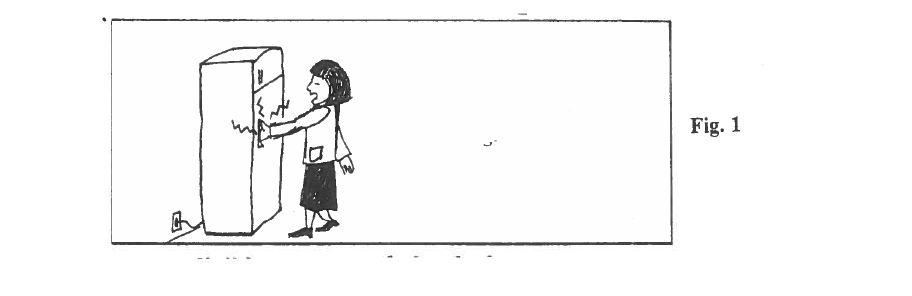
Even a negligible amount of the leakage current if allowed to flow through human body can cause a serious damage. Some of us may have heard that when someone gets electric shock he could not move himself away. This is true. Leakage current may paralyse the limbs, it is passing through. To understand the logic, how electrical leakage current affects our limbs, we have to first understand how our limbs and specially the muscles function. In human body the brain acts as a command/ nerve centre. Through the nervous system, the brain sends command signals to the limbs specially the muscles to act. The muscles obey and act according to the command signals emanating from the brain.
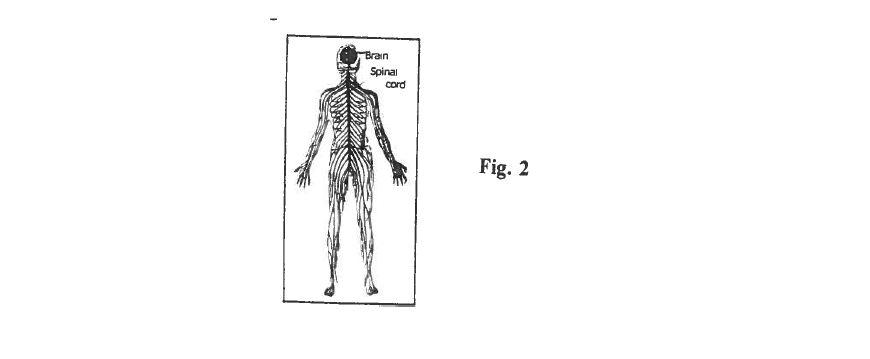
It is interesting to note that the command signals from the brain are in fact tiny electrical current pulses at a frequency of about 100 pulses per second. The muscles contract and relax depending upon the magnitude of the impulses. The degree of contraction being controlled by the peak value of the current pulses. If the magnitude of the leakage current through the human body exceeds the value of the command signal the limbs stop obeying the brain . In fact they start acting in accordance with the leakage current translated into action commands. This phenomenon is responsible for the paradox that electric currents pull the limbs in contact.
Lets study the case in Fig 1 where a person is touching a faulty appliance. The leakage current has found its route to the ground through one hand, the body and one or both legs. The brain will register the abnormality through the nervous system and will send command signal to the muscles of the hand and fingers to disengage. If the quantum of leakage current has superseded the command signal he will not be able to disengage his hand or move his legs. If the person is not aware of the actual reason paralysing his limbs, he will use his free hand to help pull away his affected one. In this process will entangle his free hand also . However if he is aware of the actual reason of his problem, he will use his free hand to switch `OFF` the appliance or through a wooden or plastic piece (non conductor of electricity) push his affected hand free.
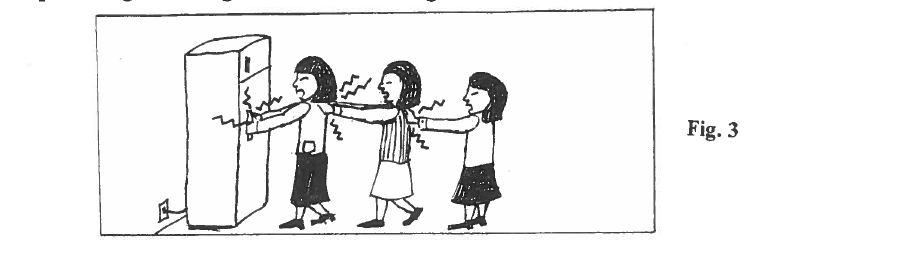
I know of one incident where one housewife got electric leakage through one hand and two legs. She entangled her free hand in trying to release the other one. When she raised alarm two of her daughters came to rescue her and tried to pull her away, and in the process got entangled themselves.
All three would have died if their son had not switched `OFF` the main.
The effect of leakage current on human body depends on its magnitude. Lets look at some specific amounts of current and effect of that current on human body in accordance with an I.EE (UK) publication. Since a very small magnitude of current can cause serious safety hazard, we will measure the current in milliampere (mA) which is 1/1000 of an ampere. A 100W lamp requires 417mA at 240V AC (standard Kuwait voltage).
a. 0.5mA to 2 mA would cause a slight sensation but harmless. b. 3 to 6 mA would give a shock but would not be very painful. According to a study published by the University of Idaho USA, 5mA is considered the maximum harmless current intensity. c. 8mA to l5mA would give a painful shock but the muscular control probably would not be affected. d. Current of 15 to 20 mA would override the command signal and the brain will lose control of the muscle. The muscles would contract completely and it would be impossible to release the grip of the hand. 20mA suddenly applied can cause crushed bones and severely torn muscles. e. A current of 20mA to 50mA passing through the chest, would cause contraction of the thorax muscles paralysing the respiratory system resulting in build up of waste material in the blood. If the current continues for a few minutes, it would cause irreversible changes in the brain. Even after cessation of the leakage current, the breathing cycle may not restart due to muscular fatigue. f. 50mA to 200mA leakage current, if passes through the heart would override the command signal controlling the contraction and expansion of the heart muscles. The individual fibrils contract haphazardly and result in ventricular fibrillation which almost stops the blood circulation. In ventricular fibrillation, the heart stops its normal beat and twitches and contracts without control. This may be fatal unless immediate C.P.R procedures are followed. g. Finally 200mA and over would cause severe burn. Muscular contraction would become so bad that chest muscles would clamp the heart and stop it as long as the shock lasts. Death would normally result.
The above data entails two essential field of study.
i. The route of the leakage current in human body and relative effect. ii. What controls the magnitude of the leakage current.
The route of the current in the human body determines the degree of danger the person is in. If the route is between two fingers, least damage is expected. In case of the person in Figl, the current would pass through the thorax muscles and heart. But one of his hands will be free. Lets consider the case in Fig 4.
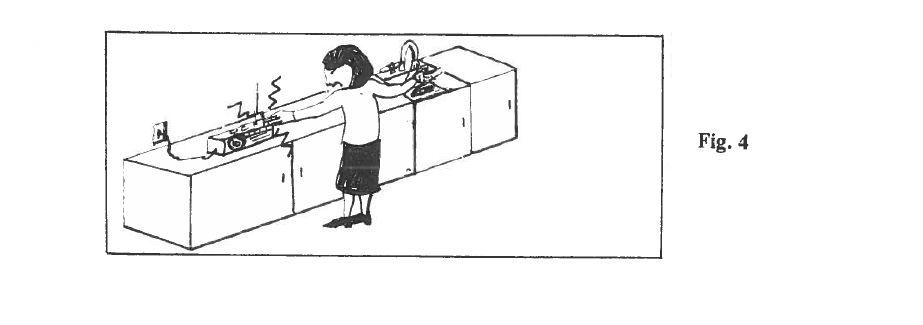
A person has accidentally touched a faulty appliance with one hand and with the other he has touched a wall or a water tap. Here his two hands, thorax muscles and heart are affected, His hands may freeze but he can still move his legs or bend his knees to make him unbalance so that gravity would make his hands free. It is highly unlikely that a person would get his two hands and two legs entangled. Almost always a hand or a leg would be free. If the person is aware of the reason of his plight he can use his free limb to cause disruption of the flow of current through his body.
However the response time depends much on the magnitude of the leakage current which can be well understood by the study of current value versus the effect. Lets study the reasons controlling the magnitude of the leakage current.
A simple formula determines the amount of current. Current = Voltage/ Resistance
The voltage in Kuwait for domestic and office appliances is 240V. So it is the resistance of the body which determines the amount of leakage current. Human body when dry has a high resistance, to the order of 105 ohms per square centimeter or greater. For a person with dry skin the initial resistance between one hand and the foot will be approximately 30,000 ohms (cumulative effect of resistance by skin and the salty fluid within the body). This will initiate a current flow of 8 mA which may cause contraction of muscles. However this amount of current, if persists for more than a second, will cause perspiration resulting in sharp drop in the skin resistance which can be as lowe as 2000 ohms resulting in a current flow of 120 mA which is lethal. The resistance between the two hands of a person perspiring slightly is about 1500 ohms, corresponding to an 160 mA current which would be fatal if persists for a few seconds. It would be very dangerous to touch or operate an electrical appliance when the body is wet due to bath or perspiration.
However if the appliance is properly grounded, then the safety equipment would disconnect the power before any accident. Even if the safety equipment fails to disconnect the power, bulk of the leakage current would flow through the ground wire. Only a small fraction would Bow through the body which may give a mild shock but can not cause potential damage.
However in case a 3 pin plug is replaced with a 2 pin plug, there will be no functioning grounding. It is the longest pin of a 3 pin plug which bonds the body of an appliance to the grounding network of the building. Simply replacing the plug with a two pin type will make the whole grounding to the appliance ineffective.
To conclude the following safety tips are to be remembered and practiced.
- Awareness is the best tool against accidents. Every individual using electricity should be made aware of the hazards, logic and safety measures.
- Never tamper with the safety gadgets in the Distribution Boards and the Panels.
- Never use a two pin plug.
- Ensure awareness about the shock treatment practices specially respiratory resuscitation.
- There should be regular shock treatment mock up practices like fire drill specially in offices, factories and workshops.
Mohammad Fakhar Mahmood Chief Electrical Engineer The Scientific Centre Kuwait