
Today when I select Light as a subject, I can see many eyebrows raised. What is so special about light that this man is trying to tell us. We all know about light. We see light; sunlight, moonlight and artificial lights. We switch “ON’ light, we switch ‘OFF’ light. Although it appears to be a simple common item, that almost everybody considers that he/ she knows everything about it, it is still an interesting subject to discuss. In my opinion 99% of the people around us know so little about the mysteries associated with light. It is interesting to note that it took almost 400 years for the scientists to fully unlock the mysteries of light. Light has baffled scientists for so long; is it wave or particle, its speed is measurable or instant (infinite), how rainbows are formed. However now that scientists like Thomas Young, James Clerk Maxwell, Max Planck, Albert Einstein have unlocked the mysteries of light, it is an interesting subject to study.
First of all, British scientist Thomas Young, through a double slit experiment in the year 1801, proved that light is a wave. Light waves when passed through two very narrow slits, at some distance from each other, later mixed up and due to construction and destruction properties of the waves, made a pattern of bright and dark patches on the screen. Bright patches were observed even where it was impossible for the light to reach if it did not mix up after crossing the slits; a typical characteristic of wave.
Fig. 1
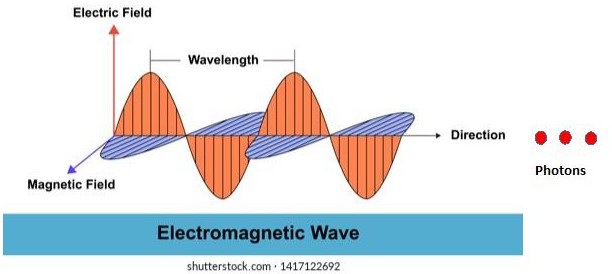
Later famous Scot scientist James Clerk Maxwell clarified the following;
- Light is a form of electromagnetic wave. Two waves propagating perpendicular to each other and moving in one direction.
- Electromagnetic waves full spectrum is as follows in terms of wavelength.
Gamma rays 1 fm – 10 pm (f stands for femto 10-15, p stands for pico 10-12)
X rays 10 pm – 10 nm (n stands for nano 10-9)
Ultraviolet 10nm – 380 nm
Visible light 380 nm – 740 nm
Infrared light 740nm – 100 µ m (µ stands for micro 10-6)
Microwave 100 µm – 10 cm
Radio wave 10 cm – 100 Km
Visible light spectrum in terms of wave length is as follows.
Violet 380 nm – 435 nm (Bandwidth 55 nm)
Blue 435 nm – 500 nm (Bandwidth 65 nm)
Green 500 nm – 565 nm (Bandwidth 65 nm)
Yellow 565 nm – 590 nm (Bandwidth 25 nm)
Orange 590 nm – 625 nm (Bandwidth 35 nm)
Red 625 nm – 740 nm (Bandwidth 115 nm)
Full spectrum of electromagnetic waves is shown in Fig. 2 below. Part of Electromagnetic waves inclusive of ultraviolet, visible lights and infra-red are generally called light.
Figure 2
Electro- magnetic spectrum
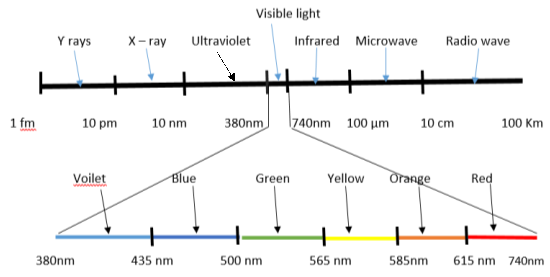
It can be observed from the spectrum that waves, gamma rays, X-ray, ultraviolet, infrared, microwave and radio wave are invisible.
In early 20th century, two clarifications came about light. Light was found to have the capacity of releasing electrons when thrown on some elements; hence light is not only wave but also particle. Scientist Albert Einstein was awarded Nobel prize based on this theory (electro-luminance. Solar voltaic cells work on this principle). Light behaves like wave but also it travels in multiple balls of particles, extremely small, massless but pack of energy. They are called photons. They are numerous, extremely small and travel with tremendous velocity. In a normally illuminated room, photons of the order of 1016 hit our retina in one second.
Note: it is interesting to note that each photon is a separate entity and their energies don’t sum up, hence our retina/ optic nerves are not damaged. It is LASER where coherent photons combine their energy and become so powerful as to even melt the metals.
In early 20th century German scientist Max Planck described through an experience (double gold leaf experiment), that light exists in discrete quanta of energy and that the energy of each photon depends upon its frequency and not its brightness.
Energy of each photon is equal to
E = ħ*f
= ħ*C/ʎ
Where, ħ is Planck’s constant and is equal to 6.626 * 10-34 joule second
C is the speed of light; 299792458m/s (rounded as 3*108 m/s)
f is the frequency of the light in Hz or cycle/second (c/s)
ʎ is the bandwidth of wave; C/f in meters.
Thus energy of each photons is directly proportional to the frequency of the photon or inversely proportional to the wavelength of the photon.
Hence in full electromagnetic spectrum, gamma rays have the maximum energy so much so that these rays can penetrate even few inches of lead and few meters of concrete (depending upon their frequency ranging from 10 pm to 1 fm). Radio wave have the least energy.
Similarly, in visible light spectrum, the red light has the lowest energy and violet/ blue lights have the highest energy. Hence some lights of low energy (like red and orange) are unable to release any electron even if the intensity is increased from 10W to 1000W. Whereas lights of higher energy like blue and green can release electrons even if their intensity is low.
Each element has an energy barrier, called Work function.
Work function of an element is the minimum energy required to release one electron from the surface of the element. Hence depending upon the formula of Energy E = ħ*f, there are elements where light of low energy such as red or orange are unable to release an electron even if the intensity (brightness) is greatly increased, whereas lights of higher energy such as blue or green can release electrons even with low intensity (brightness).
The second specialty of light is that, unlike all other waves viz. sound, heat, the electromagnetic waves (inclusive of light) do not require any medium for propagation. They can travel even in vacuum and that’s why we receive light from sun and stars where there is no medium for the propagation.
Speed of Light
The most mysterious thing about light is its speed. It has tremendous speed that early scientists including Rene Descartes believed that speed of light is instantaneous or infinite; means not measurable. Some later scientists including Galileo Galilei believed that speed of light is finite and measurable. However, his method of measuring the speed of light was not adequate as he used human reflexes to measure the speed of light. It is obvious that human reflexes are too slow compared to the speed of light. He came to a conclusion that speed of light is 10 times that of speed of sound. However, with new technics and especially with the inception of LASER (Iranian American physicist Ali Jawan discovered the first continuous LASER in Dec. 1960), speed of light was correctly measured as 299792458 m/s which has been rounded as 3 * 108 m/s.
Note: Although Theodore Maimon of Hugues laboratory is credited for developing the first LASER, in May 1960, Maimon’s Ruby LASER after consuming thousands of watt of energy was able to produce only bursts of red LASER. Because of its shortcomings, Rubi LASER could never be used in industry. Whereas Ali Jawan’s Helium – Neon LASER, consuming 25 – 50 W of power was producing continuous and extremely compact (bandwidth .0002 nm, 10,000 times narrower than that of LED) LASER beams. Within days of its inception, Ali Jawan’s Helium – Neon LASER was successfully used by Bell Laboratory to transmit audio (telephone) signal on a fiber optic cable.
Speed of light is the cosmic speed limit. Nothing can reach the speed of light. If a particle has reached close to the speed of light like 95% of speed of light and further energy is applied to it, instead of increasing the speed of the particle, the applied energy will be converted into mass, and mass of the particle will increase. Einstein formula E = m* C2
But the real mystery of light is not its speed but its relativity.
Scientists learned from their experience that every speed is relative to a reference frame. Reference frame is the position, speed and direction of the observer,
For example, if I am sitting on a chair and claim that I am static i.e. my speed is zero. Everybody near me will agree with me that while I am sitting on a chair, my speed is zero. Now consider somebody watching me from outer space. He will simply laugh on my claim. Because I am on earth and am subject to the following speeds.
- The earth is rotating on its axis with a speed of 1650 Km/ hour. (this speed of earth rotation is on the equator, and Pakistan being away from equator, my actual speed will be of the order of 1000 Km/hour). This is not a small speed to be ignored.
- Earth orbits around the sun with a speed of 104000 Km/hour. I being sitting on the earth, am also moving with the same speed.
- Entire solar system is rotating around its galactic centre (a supermassive black hole) with a speed of 800000 Km/hour. I am subject to that speed also.
But everybody around me will agree with me that I, sitting on a chair am static (zero speed). It is all because everything and everybody around me is also subject to all three speeds. Hence relatively I am static.
Albert Einstein observed that Maxwell’s formulae about the speed of electromagnetic waves, do not mention about any such relativity. His further work on the speed of light based upon Maxwell’s formulae resulted in the famous publication of Theory of Special Relativity in Einstein’s miracle year 1905. Einstein asserted that every speed is relative to a reference frame, except light. Speed of light is independent of any reference frame and is same for all observers.
In order to clearly understand this phenomenon, let us consider a simple example.
A train is moving with a fixed speed of 100 Km/hour. A man standing on the ground measures the speed of the train as 100 Km/hour.
Parallel to the train track is a road and a car is moving in the same direction with a fixed speed of 80 Km/hour. The man in the car will measure the speed of the train as 20 Km/hour. Similarly, if the car is moving in opposite direction with a speed of 80 KM/hour, speed of the train w.r.t this car will be 180 KM/hour. Relative speed of the train is different for the three observers because of their own speed, direction and location (reference frames).
For a man sitting inside the train, the speed of the train is zero. Instead, it is the trees, houses which are moving in the opposite direction. Only because we know for sure that the trees and houses cannot move, we imply that the train is moving.
However according to Maxwell’s formulae of electromagnetic waves, the speed of light (entire spectrum of electromagnetic waves) is the same for all observers. It is not relative to any reference frame. To understand this phenomenon more clearly, let us consider a man firing a laser beam parallel to a railway track. A man standing on the platform will measure the speed of photons as 300000 Km/second. Now let us consider a train moving on the track parallel to the laser beam with a speed ‘C’ i.e. 300000 Km/second in the same direction as the laser beam. Now if we ask the man sitting on the train, what is the speed of the photons? Surprisingly the man on the train will also see the photons moving with a speed of 300,000 Km/second, because according to Maxwell, speed of light is the same for all observers; meaning it is independent of the reference frame; speed and direction of the man sitting in the fast moving train.
Moreover, light cannot travel with any other speed other than ‘C” (C stands for celeritas which is swiftness in Greek and represents the speed of light 300,000 Km/second). There is no initial or starting speed for light. When we switch ‘ON’ a light bulb, the light emanates from the bulb with an initial speed ‘C’.
Surprising but true. This phenomenon led to the famous ‘Theory of Special Relativity’ by Albert Einstein. This also led to famous theory of Speed Time Dilation. Meaning that when an object moves with speed, the time itself on the moving platform slows down according to the following formula. (reference Einstein’s clock)
T = T´ (1 – v2/ C2)½
Where T is the time consumed on the moving object; airplane, rocket etc.
T’ is the time consumed on earth (stationary or slow moving platform).
C stands for celiretas (swiftness in Greek); speed of light
V is the speed of moving platform; train, plane, rocket.
This implies that clock on a moving object ticks slower than the one on stationary platform like earth.
Let us consider that a rocket is fired towards a star 4.5 light year afar. Moving at a fixed speed 90% of the speed of light, it will take 5 years to reach the star and again 5 years to come back. For the man inside the rocket when he comes back to earth, his brother on earth is 10 years older. But the man on the rocket will be older by
10{1- (0.9 C/C)2}1/2
=10* (1- 0.81)1/2 = 10 * 0.191/2
= 10 * 0.43 = 4.3 years
This means the person on the earth will be 10 years older but his brother in the rocket will be only 4.3 years older.
Since Albert Einstein floated this theory, it was impossible to verify it, because the maximum speed we can contemplate is the scape velocity of earth i.e. 11 Km/second. This speed is too small compared to the speed of light. Even with scape velocity, v2 /C2 is so small that T and T’ will be the same. The speed time dilation remained a paradox until 1955, when Cesium clock was invented. Cesium (atomic no. 55 and first element in 6th row of the periodic table)) has a resonance frequency of 9,192,641,770 Hz. When a microwave of wavelength 3.26 cm is fired on Cesium, it starts vibrating releasing 9,192,641,770 pulses in one second.
Note: Prior to atomic clock, the most accurate time measuring device was quartz clock. Quartz can vibrate with a frequency of close to quarter million times per second. Great scientific achievement but still very slow compared to the cesium clock.
Cesium clock had few construction shortcomings. Cesium’s melting point is 28.44 OC. It starts melting on room temperature. Moreover, it requires very sensitive electronic digital device to register;
- 9 pulses to advance the clock by 1 nano (10-9) seconds.
- 9,192 pulses to advance the clock by 1 micro second
- 9,192,641 pulses to advance the clock by 1 ms.
With the development of Cesium clock (also called atomic clock), it was possible to measure time differences of the order of microseconds. Two synchronized cesium clocks, one in the laboratory on earth, and another on a plane making 3 rounds around the earth were studied. Since it was not possible to increase the speed of the moving platform, it was considered to increase time considerably so that the effect on the clock on moving platform could be measured. The Cesium clock on the plane was found to tick few microseconds slower than the synchronized clock on the ground, a value exactly as computed by Albert Einstein’s formula. Hence it is no longer a paradox, but a proved theory.
For a common man it is difficult to contemplate that time itself slows down on a moving objects. However, on slow speed and with normal clocks, it is too small to be noticed.
Now instead of going further on speed time dilation, we move to another paradox pertaining to the speed of light. There is a term optical density. Density is a relation between mass and volume of an object. Optical density is a factor by which the speed of light slows down in a transparent material; which is as follows.
Glass 1.5 – 1.6 depending upon the quality of glass
Diamond 2.4
Gallium Phosphate 3.5
The phenomenon of light slowing down in transparent medium contradicts with the discussion we made earlier that light can and will travel with one speed only i.e. ‘C’. And we also agree that speed of light slows down in a transparent material. The two theories look contradicting each other and need scientific clarifications. The clarification of this contradiction does not lie in the laws of classical physics (Newtonian Physics) which we notice and apply in our daily life. The answer lies in the laws of Quantum Physics; the physics of the very small, or laws of sub-atomic world (the world inside an atom), where particles behave in a weird manner and don’t follow the laws of the classical physics.
Before we discuss quantum physics, let us take one simple example.
Fig. 3
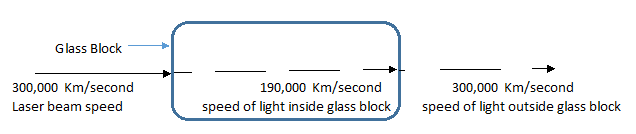
Let us look at Fig. 3. A laser beam has been fired on a block of glass. Speed of light hitting the block is 300,000 Km/ second. Due to optical density the speed of light within the glass block is reduced to 190,000 Km/second. However, the moment the laser beam exits the glass block, it takes its normal speed ‘C’ (300,000 Km/second). According to the laws of classical physics, speed cannot jump from 190,000 Km/second to 300,000 Km/second without an accelerating force on the edge of the glass block. We know there is no such accelerating force there. Hence it can be inferred that the speed of light within the glass block appears to have been reduced but not actually reduced. In order to know the reason of apparent reduction of speed, let us study the structure of an atom and study the laws of motion inside the atom. In Fig 4 we study how atoms/ electrons behave within an atom.
Fig.4
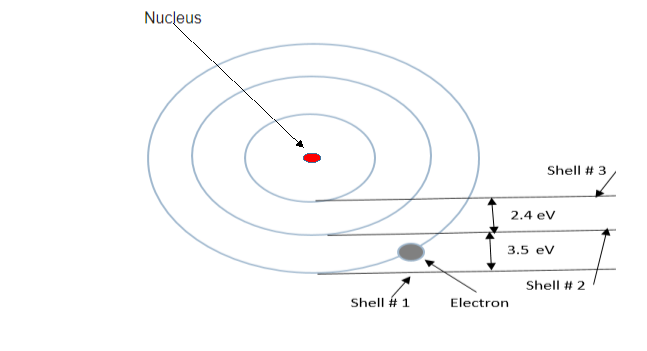
Δ E2 – E1 = 3.5 eV. Δ E3 – E2 = 2.4 eV.
The above diagram is of an imaginary atom with 3 shells or energy levels. The electron on the first shell (energy level) belongs to the first shell and is considered to be on ground state (it is where it belongs to in equilibrium state; i.e. at 0 Kelvin). If the atom is subject to some external energy such as light, heat, the electron will tend to jump to the next energy level. However, the sub-atomic world follows a different and more complex physical laws which is called quantum physics or quantum mechanics. Let us consider that energy difference between the first and second shell i.e. Δ E2 –E1 is 3.5 eV.
Note: The atoms are extremely small in size; the largest atom, cesium, atomic no. 55 has a size of 600 pm; p stands for pico; 10-12). Hence the energy within an atom is so small that they are referred to in a much smaller unit, eV (electron volt). 1 electron volt is equal to 1.6 * 10-16 joule.
When the atom is pumped with external energy, the electron on ground state absorbs that energy. However, it will not move from its place unless the pumping energy reaches equal to or exceeds the difference in the two energy levels. That means if you pump 3 eV of energy, the electron will not move. Increase the pumping energy to 3.49 eV. The electron still does not move. The moment the pumping energy reaches or exceeds 3.5 eV, the electron will disappear from first energy level and re-appear on the second energy level. Not even for an extremely brief period of time, electron will be in between two energy shells.
Note: The electron after receiving the required pumping energy and having jumped to a higher energy level, is called to be on stimulated state. The electron is unstable on its stimulated state and tends to return back to its ground state. An electron does not stay on stimulated state for more than 100 µ seconds and decays back to its ground state; the orbit it belongs to normally. In this process of decay, it releases a photon having energy equal to the difference in the two energy levels. This is called instantaneous emission of radiation, and this is how artificial lights are produced; incandescent, gas discharge, LED and all.
Now let us consider the lattice of atoms in a block of diamond. I am not selecting glass or gallium phosphide because the lattice is slightly complicated because both comprise of two elements; glass comprising of silicone and oxygen and gallium phosphide comprising of gallium and phosphorus. Hence for the ease of understanding I am taking example of diamond block which comprises of atoms of one element, carbon. Let us observe the lattice of carbon atoms in a diamond block, shown in Fig. 5.
Note: Carbon atom has only two energy levels.
Fig.5 Lattice of Diamond atoms
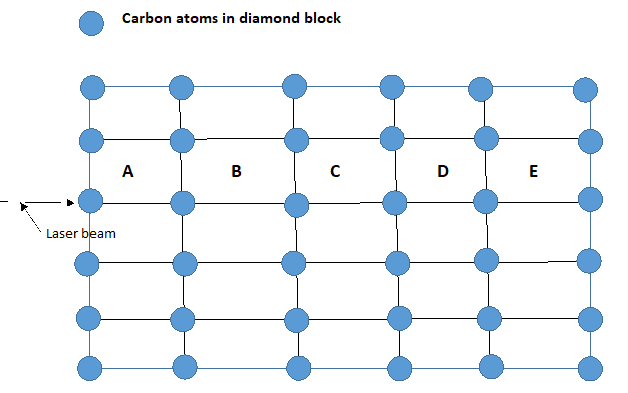
A laser beam has been fired on a block of diamond. Before the beam hits the first atom, it is travelling with its normal i.e. ‘C’ (300,000 Km/second). The moment the light hits the atom, its energy is absorbed by the electron, but the electron keeps on judging, whether the energy it has absorbed is equal to or exceeds Δ E2 – E1 (assuming 3.5 eV in Fig. 4) meaning is it adequate for the electron to jump to next energy level. In case of transparent materials, the pumping energy is generally smaller than, but close to the required energy e.g. 3.45 or 3.48 electron volts. When after considerable time the electron/ atoms determines that the absorbed energy is not equal to or exceeding the required energy to jump to another shell, it releases the energy in the form of photon of same frequency (energy is directly proportional to the frequency of the photon). Later the photon will move with speed ‘C’ until it hits another atom. In figure 5, the photon will cover the spaces, A, B, C, D & E with speed ‘C’ but waste considerable time whenever it hits an atom. Subsequently when the photon will exit the diamond block, it will attain its natural speed ‘C’. So the total time taken by the photon between entering and exiting the diamond block will be larger than, it should normally take to cover that distance. Hence the apparent speed of light within the block will appear to have slowed down compared to ‘C’ depending upon its optical density.
Having said that a question appears in the mind of a common man, do electrons think like human? How can they think and take decision to jump or not to jump to another level? Strangely the answer is ‘Yes. Electrons think like human being. However, this is not my statement. This is the statement of great physicist, Nobel laureate and one of the specialists in Quantum Physics, Dr. Friedrich Hund. This he has explained in his Hund’s rule of electrons occupying the space in orbitals, and his famous Empty Bus Seats theory. However, we do not want to deviate from the main subject and let us conclude our discussion about light, its speed viz. a viz. optical density.
- Light will always travel with only one speed, ‘C’. There is no initial speed or slower speed.
- Speed of light is the cosmic speed limit. Nothing, having a mass, can reach the speed of light.
- Photons are particles but have zero mass.
- Speed of light is independent of any reference frame. It is same for all observers, even if the observer himself is travelling with speed ‘C’.
- Because the speed of light is independent of a reference frame (same for all observers), it is the time which slows down on a moving platform. A clock on a moving platform will tick slower than another synchronized clock on a stationary (or slower moving) platform.
- Light appears to have slowed down in a transparent matter due to the time wasted by the electrons to judge whether the pumping energy is equal to or exceeds the difference in the energy levels of two shells.
M. Fakhar Mahmood
Electrical Engineer by profession
9th June 2021
Graphics & Figures by
Fatima & Javeria